Fluval FX4 External Filter (1000L, 2650 LPH)
Item Number: A214
UPC Code: 015561102148
Description
Recognized as the “workhorse of canisters” for their legendary strength and durability, high output FX Series filters sweep the tank harder and faster to retain a greater amount of debris. Combining patented SMART PUMP™ performance-optimizing technology with auto start/stop operation and intricate multi-stage cleaning featuring an expansive basket-in-basket media tray design, FX owners will spend more time enjoying their aquarium, and less time maintaining it.
Features
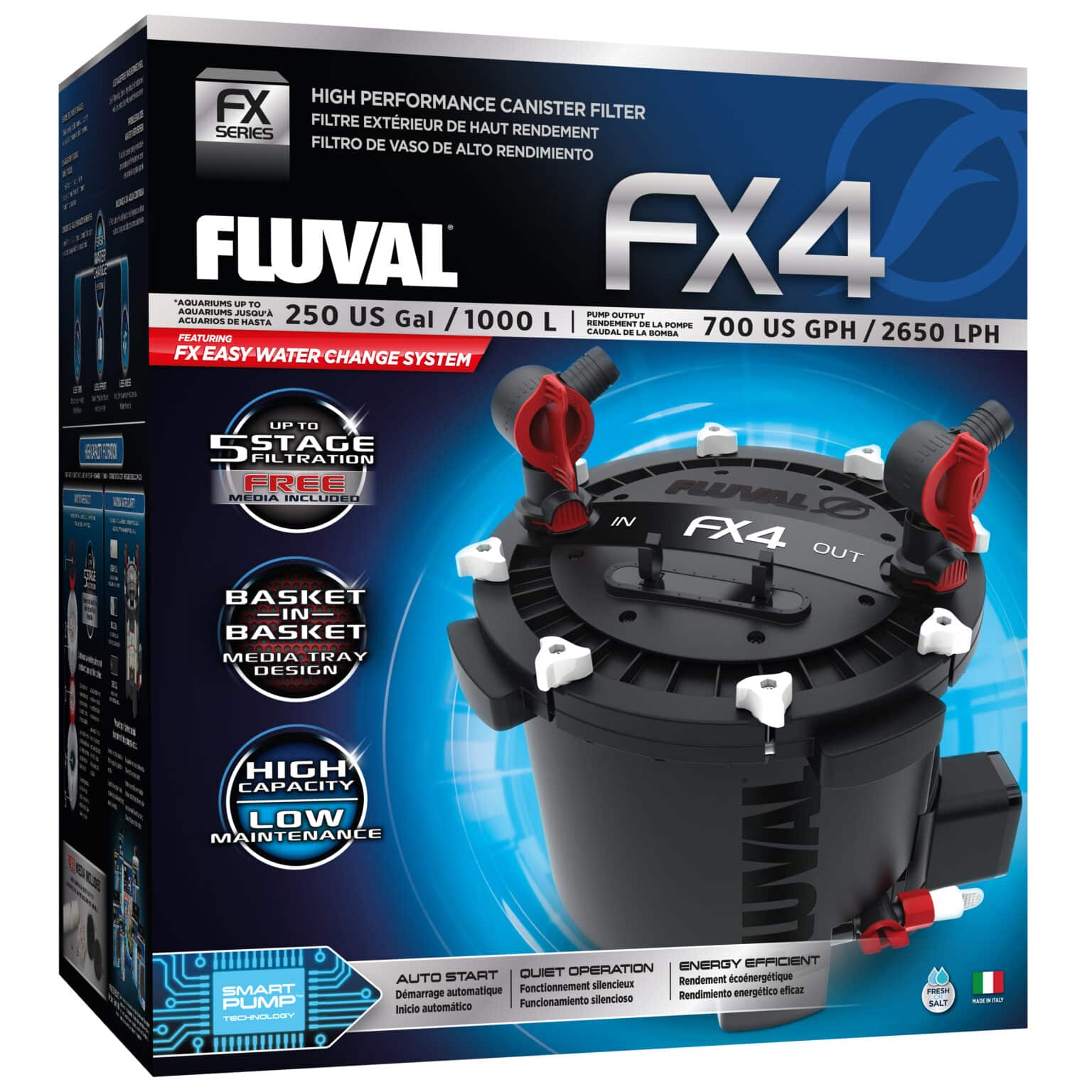
- Multi-stage filter pumps out 700 gallons (2650 L) of water per hour
- Smart Pump™ – advanced microchip technology continuously monitors and optimizes pump performance
- Self-starting – just add water, plug in and Smart Pump™ will take over. Trapped air auto-evacuated every 12 hours to ensure maximum efficiency
- Easy water changes eliminate need to lift heavy buckets. Simply attach hosing to output (Kit sold separately) and Smart Pump™ does the rest
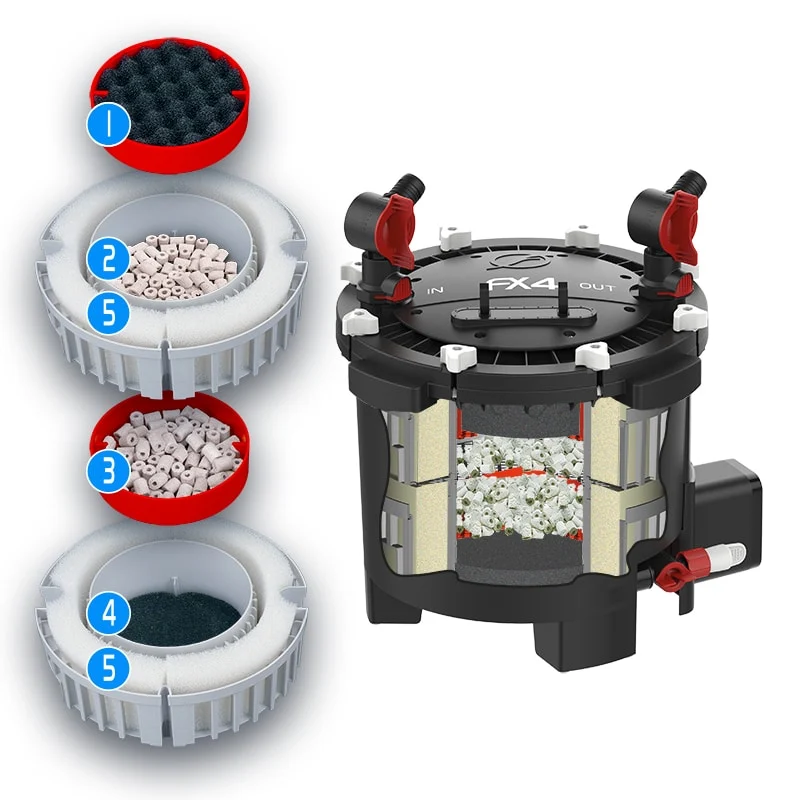
- Removable, stackable media baskets eliminate water bypass and hold a total of 1 gallon (3.9 L) of media
- All filter media included – mechanical, chemical and biological
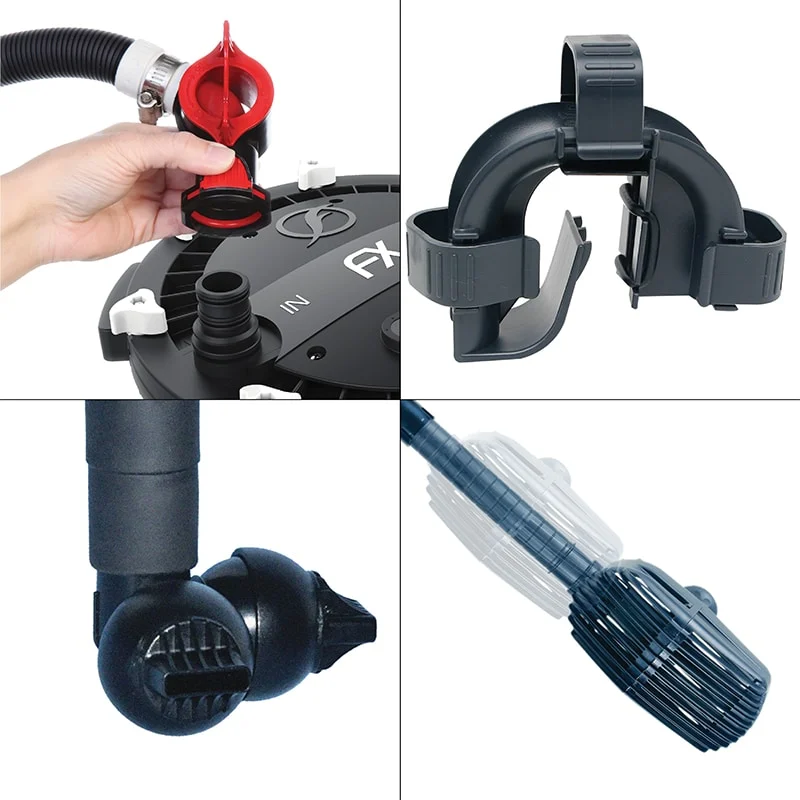
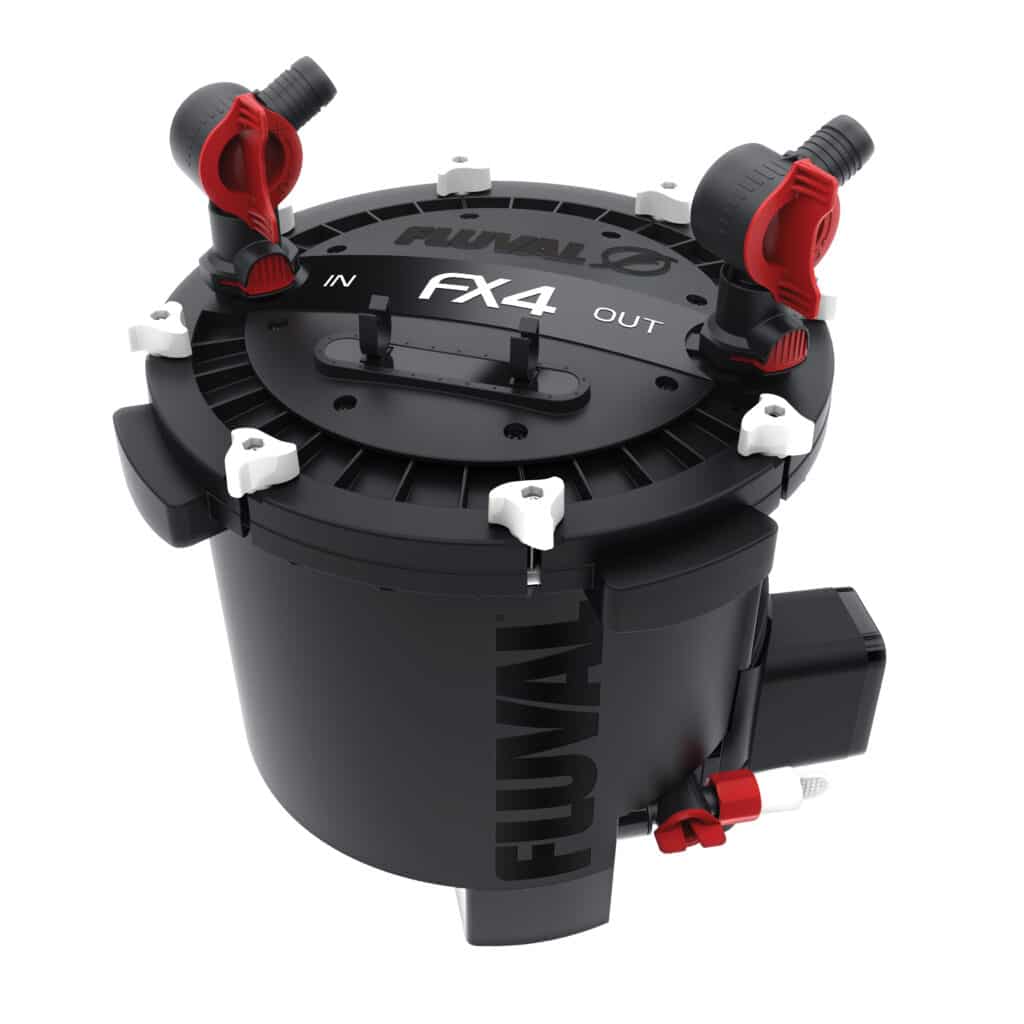
- Aqua-Stop valves with leak-proof Click-Fit attachment system
- Valves positioned at convenient 45-degree angle for easy installation and rotation
- Anti-clog, telescopic strainer ensures continuous water flow
- Multi-Directional Output nozzles can be fully adjusted to create customized water flows
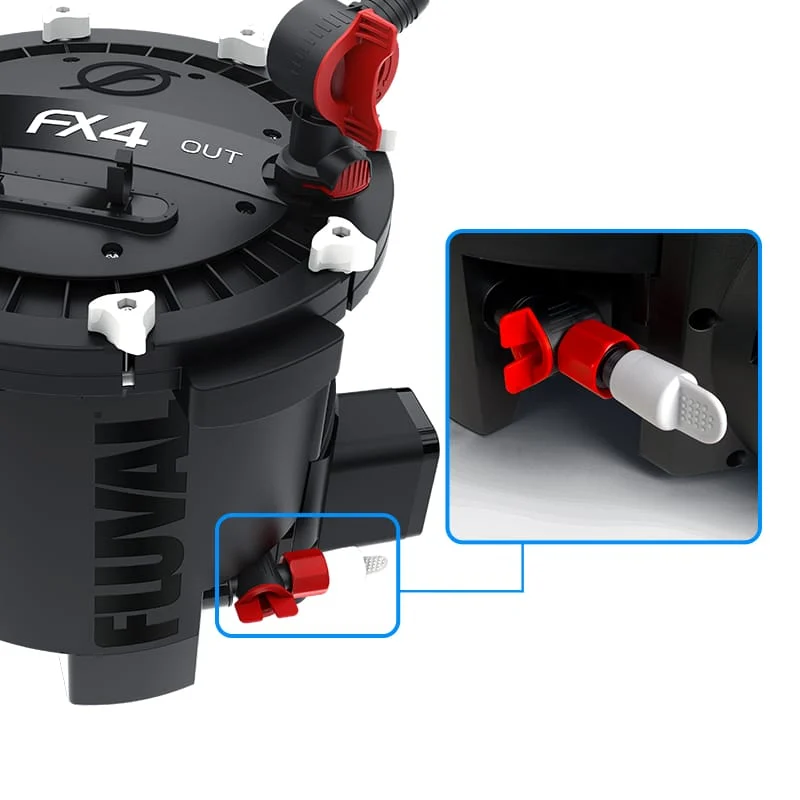
- Utility Valve with drain hose for easy maintenance and flushing of canister
- Rubberized feet help ensure quiet operation
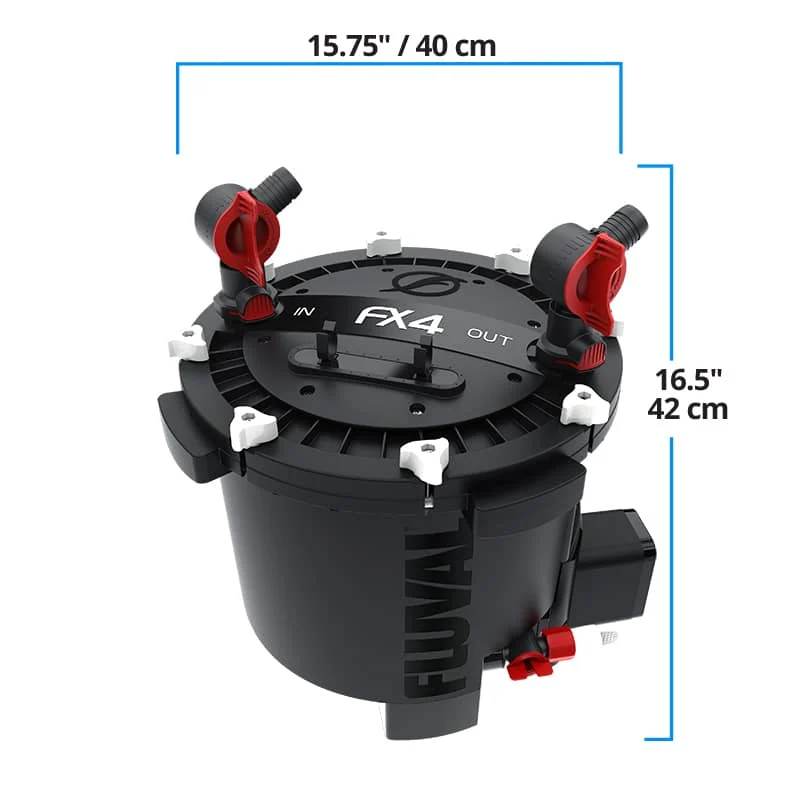
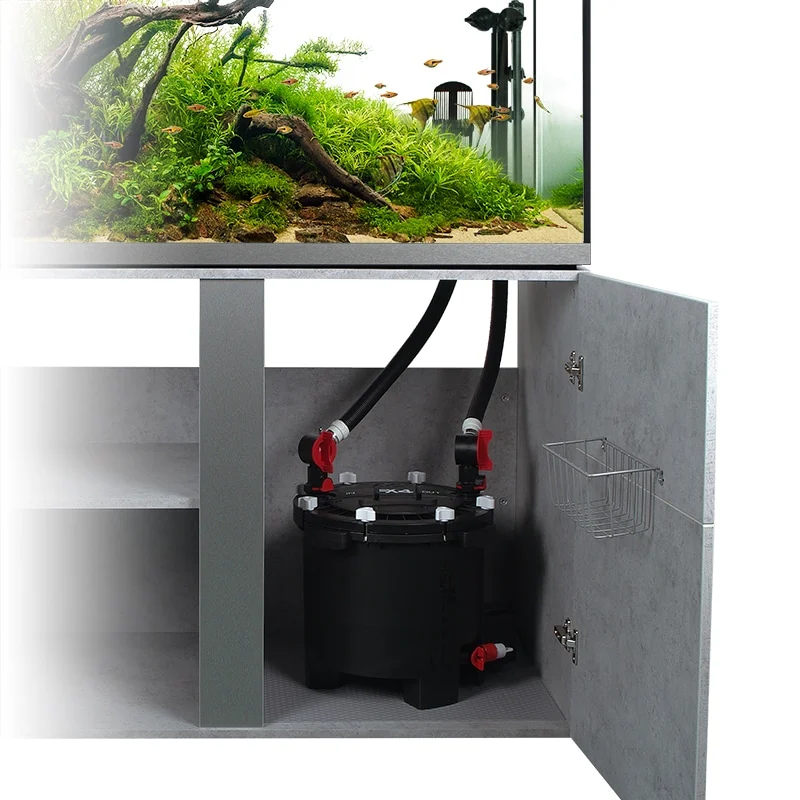
- Compact 16.5″ tall design – easily fits under most aquariums
- Made in Italy
- For use in freshwater and saltwater aquariums
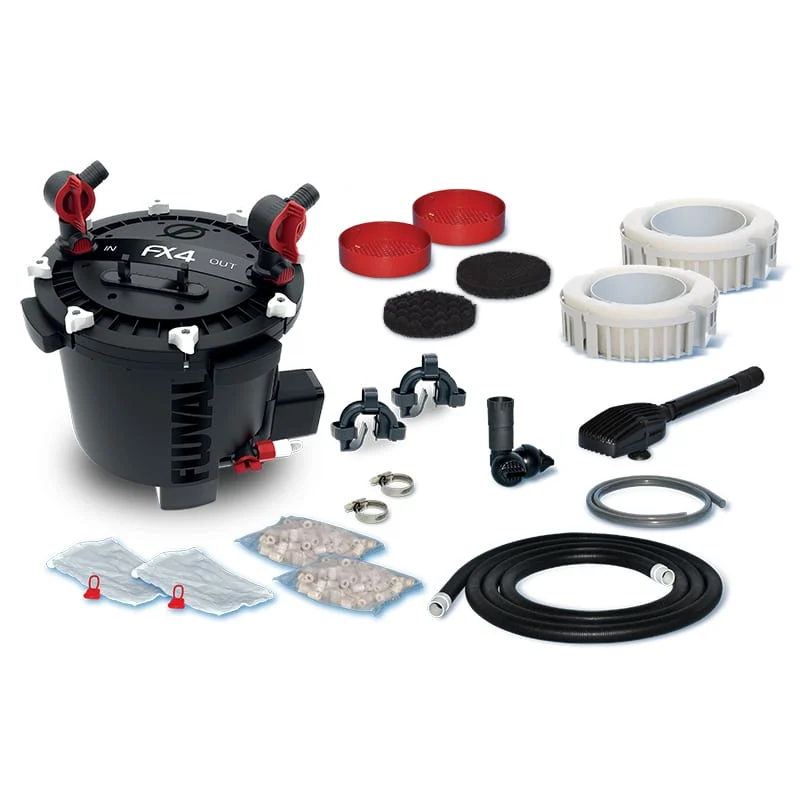
What’s Included
- Ribber hosing
- Rim connectors, clips and suction cups
- Intake stem
- Output nozzle
- Lid fasteners
- Filter canister
- Utility valve and hosing
- Drain cap
- Pump unit (motor) and power cord
- Rubbert feet
- Media baskets
- 1/2 media baskets
- Filter lid and accessories
Questions & Answers
You’re experiencing FX Series Smart Pump technology hard at work! Once plugged in, the filter’s electronic priming sequence begins: the pump runs for 1 minute to fill the canister with water, then stops for 2 minutes to evacuate air, and then restarts. This sequence repeats itself every time the filter is unplugged, and every 12 hours to help evacuate air that may have become trapped inside the canister!
The water first moves to the bottom of the canister, and then rises to the top through the foam pads. It then passes back to the bottom of the canister through the media trays in the middle, before finally being returned to the aquarium.
Fluval ribbed hosing is beneficial for a number of reasons! It’s quick and easy to install, does not kink or collapse over time, is not influenced by temperature, maintains a wide, constant water flow area over the aquarium rim, and its aesthetics are not compromised over time. Most importantly, Fluval ribbed hosing provides superior clog resistance to help prevent loss of flow rate: third-party testing has shown that after only 4 months of operation, a 36% decrease in flow rate was observed with standard PVC hosing, whereas only a 1% reduction in flow rate was observed with Fluval ribbed hosing after 7 years of operation.
Fill the canister about halfway before starting the filter. More specifically, ensure there is at least 1.4 US Gal / 5 L of water in the FX2 canister, 1.6 US Gal / 6 L of water in the FX4 canister, and 2 US Gal / 8 L of water in the FX6 canister before starting the filter.
The screws are self-tapping galvanized screws, TBC cross UNI 6954, 4.2 x 9.5 mm, A4T.
The utility drain valve is compatible with 5/8″ / 16 mm hosing.
With the Aquastop valves and hosing installed, the FX2 / FX4 are 18″ / 46 cm tall, and the FX6 is 21″ / 54 cm tall.
Check your filter’s impeller and impeller shaft, as it’s possible either of these are damaged and need to be replaced, or are very dirty and require cleaning. Also verify that the filter has been properly primed: always ensure that the filter output is above the water surface when priming.
Noise originating from the motor suggests that the impeller assembly needs to be replaced. As the only moving part in your filter that operates 24 hours/day, the impeller does eventually wear and is therefore not covered under warranty. Also, verify that the filter has been properly primed (always ensure the filter output is above the water surface when priming), as this will help ensure trapped air is not the cause of the noise.
FRESHWATER: It’s important to perform regular filter maintenance (media rinsing and replacement) to prevent media from compacting, which can result in air accumulation. Ensure the filter intake is not positioned near an airstone or any other source of air bubbles in the aquarium. Verify the integrity of the intake rubber hose connector that attaches to the intake siphon tube, as it does dry out over time and becomes hard and non-flexible, thus requiring periodic replacement. Also verify that the joint between the intake rubber hose connector and the intake siphon tube is positioned below the water surface. Lastly, ensure that all rubber gaskets and O-rings have been cleaned and lubricated with Fluval Silicone Lubricant (Item #A325), and that there are no kinks, loops, bends or turns in the hosing. SALTWATER: In addition to the above, verify that the filter is not taking in the fine air bubbles introduced to the aquarium by protein skimmers. Make sure to use an effective bubble trap at the skimmer output or within the sump to prevent this from happening.
We do not recommend the use of Vaseline or vegetable oil, as both can cause rubber O-rings and gaskets to degrade and fail. Use Fluval Silicone Lubricant (Item #A325) regularly to effectively prevent leaks!
<iframe width="100%" height="439" src="https://www.youtube.com/embed/SpWyLzXY3PA" title="HOW TO: Fix Your Aquarium Filter" frameborder="0" allow="accelerometer; autoplay; clipboard-write; encrypted-media; gyroscope; picture-in-picture; web-share" referrerpolicy="strict-origin-when-cross-origin" allowfullscreen></iframe>
The currents in the natural habitats of fish are, in general, much stronger than the water movement in an aquarium. If a fish became stuck to the intake of your filter, it’s likely that it was sick and weakened. Take note that you can adjust the output flow strength of your filter to best suit your particular fish species.
No. It’s better (and easier) to prevent odors rather than having to remove them once they’ve accumulated. Some fish are messy eaters, or are more prone to producing large amounts of waste, so prevention is key.
You can safely turn down the output AquaStop by 50% in order to reduce flow without damaging the filter’s pump.
FX Series filters are closed recirculation filter systems: when used within the defined parameters, head height has no real impact on performance. Instead, the length of tubing and the types of filter media are key factors affecting filter output performance. We recommend never exceeding the specified vertical distance in your instruction manual as this will cause the filter to exceed the maximum head pressure value, which could cause the filter to leak and fail.
No. Fluval canister filters use ribbed flexible hosing, which is not ideal for installing such equipment.
This white, slimy film is bio-film, and it is harmless. We recommend cleaning canister filter hosing and rubber hose connectors as part of normal maintenance to help mitigate the growth of bio-film.
This usually indicates an increased load on your filter due to either the growth of your fish, the recent introduction of additional fish, increased waste production (leftover food, excrement, etc.), or clogged filter media in need of replacement.